
Ballad of the Bride
Attributions
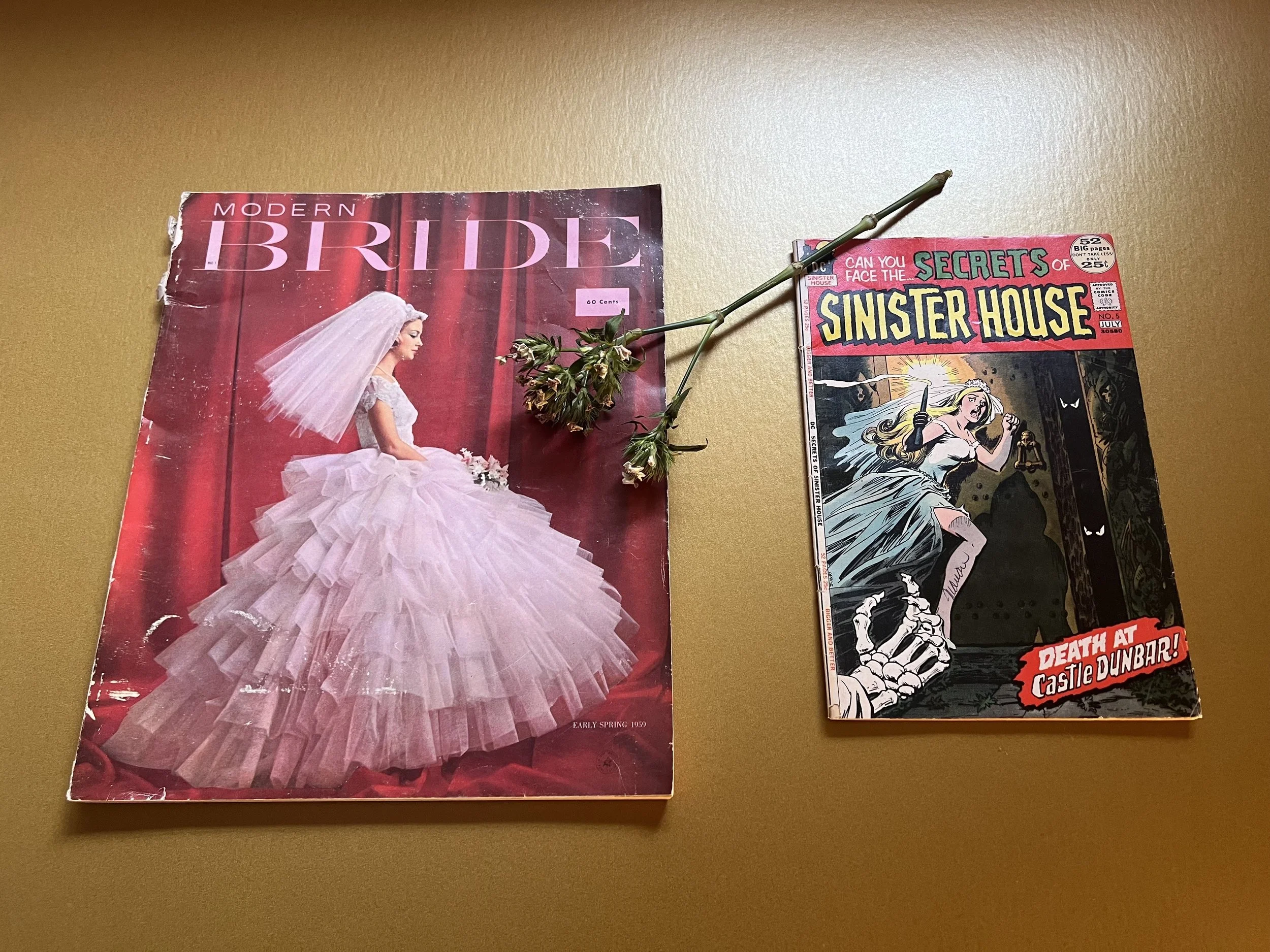
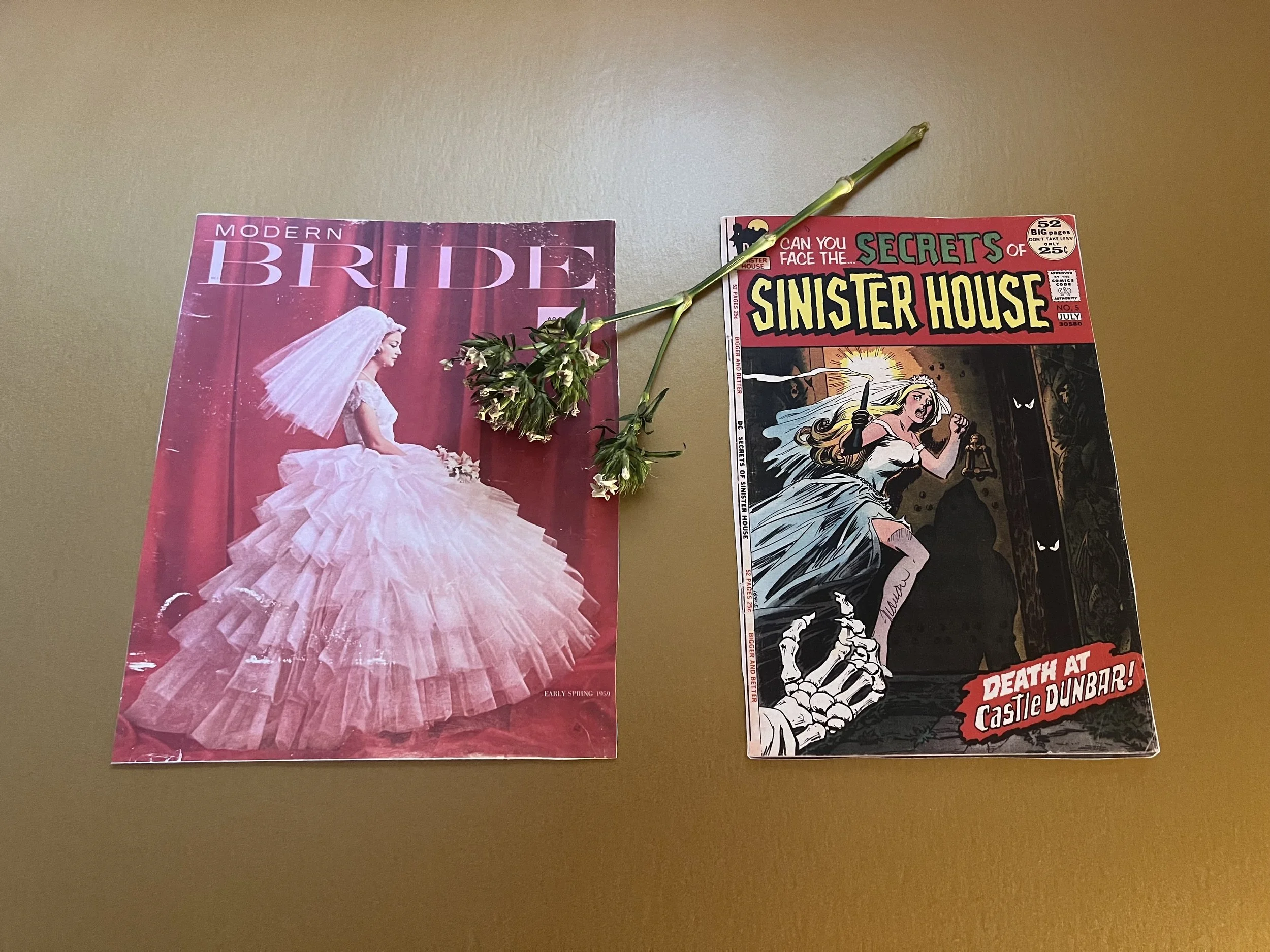
Modern Bride magazine, early Spring, 1959
Gown by Arden of Campus Bridals
Cap by Mademoiselle Bridals
Flowers by Irene Hayes
Photo by Milton Greene
Model not identified
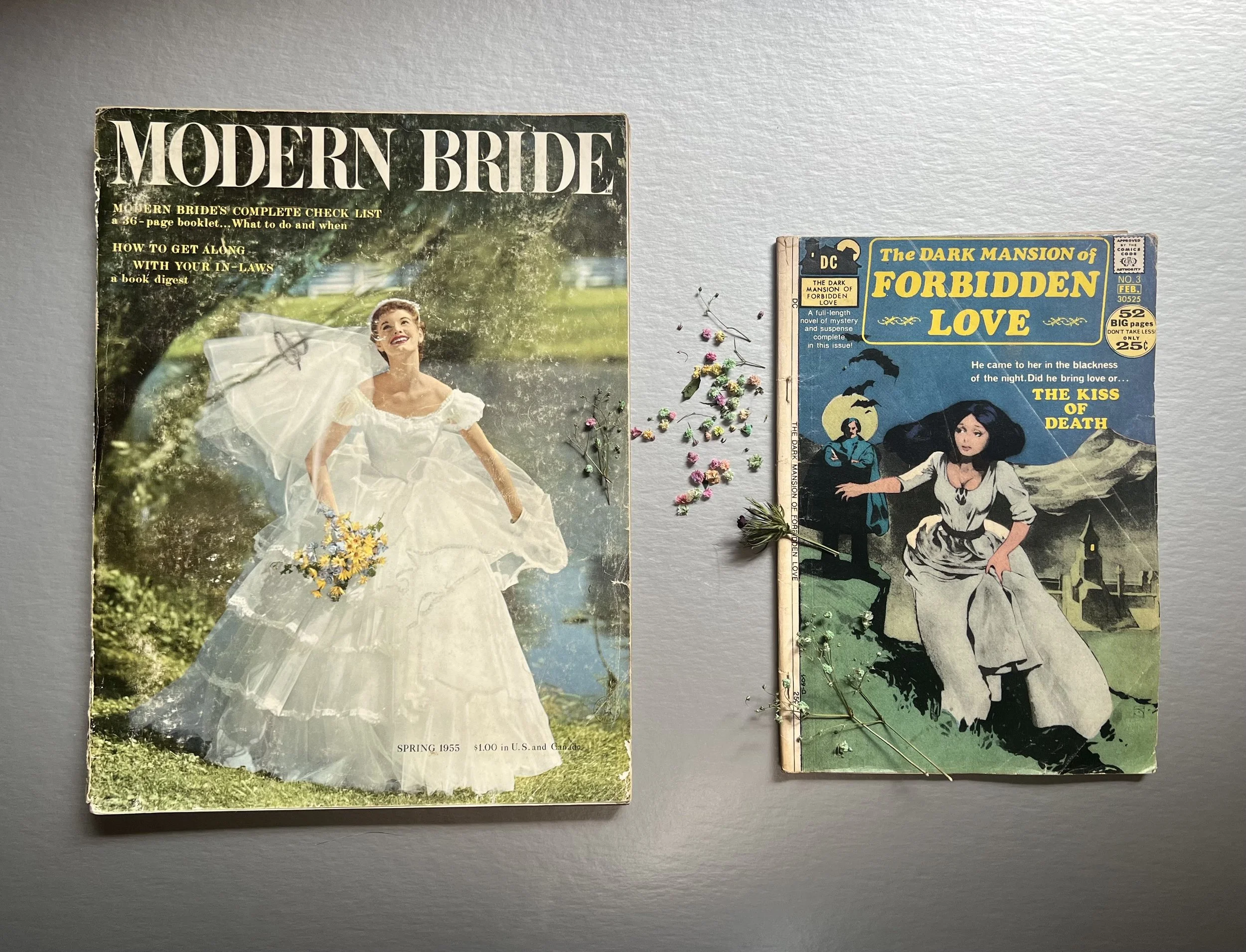
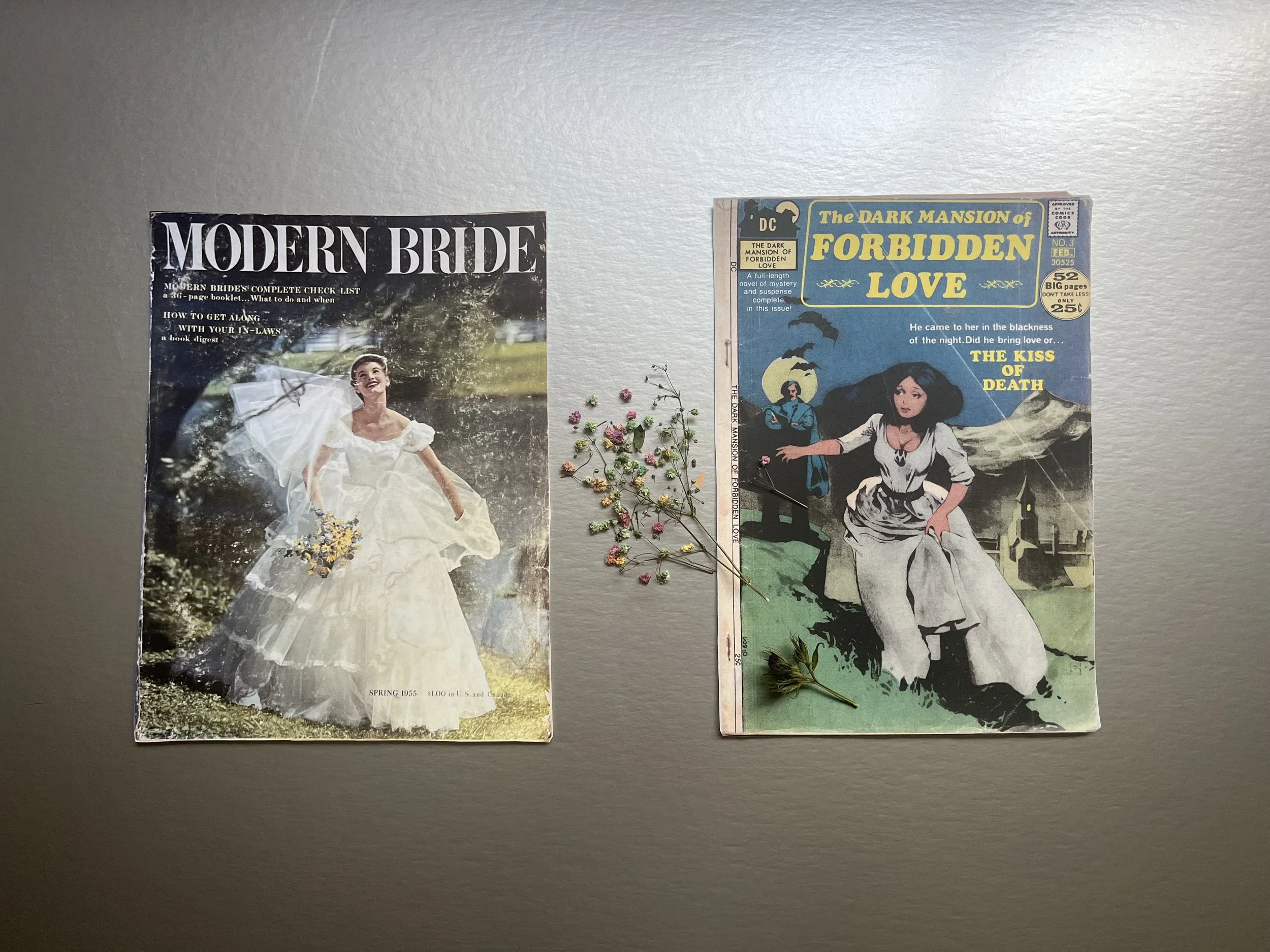
Modern Bride, Spring, 1955
Gown by Maurer Originals
Headdress by Miss Lillian for Vogue Bridals
Flower arranger and model not identified
Photo by Edgar de Evia
Secrets of Sinister House
July, 1972
Cover Art by Nick Cardy
The Dark Mansion of Forbidden Love
Jan. - Feb., 1972
Cover art by Jeff Catherine Jones
Artist Statement
This artwork began with a comic book cover. The image of a white-gowned woman fleeing danger in the dark is one of my treasured mind-pictures from childhood. I read a lot of comics in the 1970s when I was a kid, and that image is the one that stayed with me. I also often remembered images of brides from the bridal magazines I read, women grandly attired, smiling and enshrouded.
I searched for the comics on e-bay, and found surprisingly few. But the ones I found really seem similar to the ones in my memory. I also searched for magazines with bridal images that I remembered from childhood. Alas, I couldn’t find them! But I found magazines I fell in love with, weighty and beautiful.
I took two sets of photos for each assemblage of covers with flowers: one of the actual and original bridal magazine and horror or romance comic, and one of a copy I made of their covers.
When I was a kid, reading was my pleasure: comics, books, cereal boxes. Magazines and album covers. Stories I drew and wrote, enacted and directed. I fantasized a lot, usually about being alone in nature. I was wearing a beautiful gown in my fantasies. Marriage seemed like a convenient reason for wearing a beautiful gown, so I tried to fantasize about that, but the groom stymied my narrative. A church felt confining with its walls. So I just dreamt up the dress and the cake and the crowded party - that’s what I really wanted. A tiara! Possibly a fan. And the feeling of celebration!
I did like the words: Proposal. Fiancé. Invitation. Cathedral. Ceremony. Wedding. Bride. Bouquet. Veil. Vows. Chandelier! Champagne! Honeymoon!
To have friends and family you love, who love you! Maids and matrons of honor! A dance floor!
Music! Epithalamia (marriage songs) sound as delicious as frosting, poetry like pearls and a gold Cupid with a sweetly painful bow and arrow. The pierced heart, sweet love I curse and praise you! A man beseeching on bended knee, presenting upraised an open velvet box with a diamond ring set on satin and in platinum. The binding of marriage was made to seem like a romantic bond based on the secret life of the erotic. A commitment to embrace.
The raised veil of netting. The white satin atop sheer white stockings! Sexy revelations, pillow talk private.
I loved the materials of the gowns and the possible tastes and scents of the banquet and the idea of reciprocated love. A live band, a DJ, an MC!
The “something old/something new/something borrowed/something blue” talismanic tradition, a poetic recitation with rhythm.
I loved the clanking cans on a car festooned with ribbons and merry graffiti! The shower of rice or rose petals! The wedding cup. The white and red of the bride and the black and white of the groom. The bride and groom feeding each other cake from a slice they cut together, the shared knife!
The gaily wrapped presents and gifts! That the bridal gown looked like dessert! The bouquet of flowers! And the flowers in flight for someone to catch, an oracle!
The romance and mystical mood of the ceremony and wedding night, dreamy and dark and adult. The garter belt. The bridal nightgown. The bridal chamber, The marriage bed, its clean expectant bedding, its rumored bloodstains and drops of fluid. Taking a slice of cake home, carefully wrapped in wedding napkins, to put under the pillow, its frosting roses pressed, to dream of one’s future husband. Happily ever after dreams! The suggestion of the sensational intimacies of menstruation and orgasm.
When I looked for bride magazines on e-bay, I searched for those intimate advertisements that I remembered from childhood. The ads were usually soft focus, of a woman’s face in close-up, her shoulders bare or in something delicate and beige or white with maybe pink. The ads were like flesh and promises. I loved the flowers.
It took awhile for me to realize that flowers are killed when they’re plucked for bouquets. The flowers in this artwork were from a party. But I didn’t pluck them; I waited until the petals and buds fell naturally to include them in the art.
Getting married felt like a trap to me. Even as a kid, as a teen, as a young woman getting older - I just detested the idea of marriage. Dowry sounded dour.
I don’t know why I never wanted to marry. Each of three main and forever loves in my life could have been my fiancé; one was quite appealingly storybook romantic about it, and the other two sexily cavalier in their courting. A fiancé in a tuxedo felt validating, protective, reassuring - a pronouncement to the public of a secret love of my own. The engagement announcement of belonging. It's official! A proclamation in the unscrolling of my heart. But as the years have piled up so too have my reasons for not marrying but the basic fact is plain: I never wanted to. Never. It feels adamant. I made it plainly clear to boyfriends and lovers, too.
Marriage as political alliance or power-seeking ambition, daughters and wives as property. The bride and groom getting no say in whether to marry. Underage females forced to marry. Having sex with someone despicable, or without desire or sensuality or passion. Legalized rape. That marriage was confined to heterosexual couples and also that it sanctioned baby-making. The legal cost of getting married or divorced, the expense of the wedding, the hassle of divorce. The financial and emotional burden of ruin. The unrealistic expectations of being wedded. The hurt feelings of not being invited! Of not being able to attend!
That the female’s last name goes from being her father’s to her husband’s, Adam’s rib, Miss or Mrs for her but forever himself a Mr. (until Second Wave Feminism and sexual liberation during the late 1960s and early 1970s gave us Ms.) The bride handed by the father to the groom, the truth of patriarchal domination and exploitation veiled in pretty lace and fragrant bouquets. The two became one but the female was subsumed - just as she is in language. Money combined and so too all liabilities. The huge expense of it all.
The ceremony in a church made a marriage seem serious and important. The marriage certificate felt oppressively, impressively official. The bride’s slow walk as the music played and everyone watched, the spectacle of femininity in a ceremony of legitimized sexuality. Or normalized rape - forced marriages, sex trafficking, capture and enslavement. That underage girls were considered consenting.
Bridal showers made me anxious, all the presents about baby-making.
The fashion show usually climaxes with a bridal gown. Signifying what writer, Carolyn Heilbrun, identified as the gendered plot quest: while the plot quest for males is historically adventure, for females the plot quest is historically the male. Life ends and begins with marriage! The scattered petals and seeds! The confetti and flowers of sex and death! The stem and flowers in this artwork seem skeletal to me.
Oh the grand parade of ego asserting itself and insisting its lineage! The procession of patriarchal oppression, all dressed up in romance and Eros, satins and silk, ribbons and lace, a hidden face. The danger of the binding kiss. Gold rings gleam a distraction from its shackling. I now understand that the influence of religion and of the state or country shaped marriage, that marriage is about the control of the body and reproduction. I see that marriage is one more example of how difficult it is for humans to accept and endorse freedom as a way of being and of living.
Old maid, spinster, crazy cat lady - all terms that shame the aging unwedded female. The loneliness of not being wanted, the terrible isolation, the mortifying rejection. The I like a solitary tree in the elements, the we in the cozy house of their gold ring. Forever outside the golden couple, their shared golden ring ever exclusive, exclusionary, excluding. A cruel clique cozy for the couple and condemning for all others. Snug and smug.
But freedom in nonconformity, freedom! Authenticity and exhilaration! The I unwedded is the I liberated.
The more research I did for this artwork the more validated I feel about not having wanted to marry anyone ever. And the more I want a wedding! The bridal gown and cake! Pretty jewelry, dancing, ceremony! The celebration!
Bibliography
Appel, Rebecca. “8 Extravagant Weddings from Art History.” Google Arts & Culture.
https://artsandculture.google.com/story/8-extravagant-weddings-from-art-history/eQUxCI_wifGXKg?hl=en Digital link. Accessed 3.1.26.
Bauer, Andrea. “Paintings of Love and Marriage in the Italian Renaissance.” The Met. Timeline of Art History. November 1, 2008.
https://www.metmuseum.org/essays/paintings-of-love-and-marriage-in-the-italian-renaissance
Digital link. Accessed 3.1.26.
Brennan, Summer. “A Natural History of the Wedding Dress.” JSTOR Daily. September 27, 2017.
https://daily.jstor.org/a-natural-history-of-the-wedding-dress/ Digital link. Accessed 3.13.26.
Everitt, Lauren. “Ten Key Moments in the History of Marriage.” BBC News Magazine. March 14, 2012.
https://www.bbc.com/news/magazine-17351133
Digital link. Accessed 3.1.26.
The Dark Mansion of Forbidden Love
Jan. - Feb., 1972
Modern Bride magazine, early Spring, 1959
Modern Bride, Spring, 1955
Secrets of Sinister House
July, 1972
Stritoff, Sheri. “How Long Has the Institution of Marriage Existed For?” Brides. November 19, 2025.
https://www.brides.com/history-of-marriage-2300616 Digital link. Accessed 3.1.26.